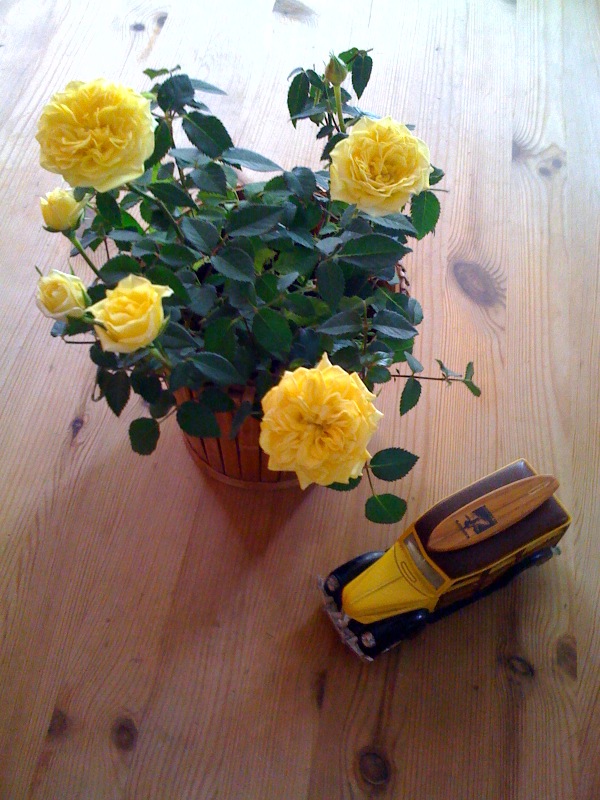
Betwixt and Between

San Diego is crisscrossed with wild and coyote-filled canyons. A few of these canyons divide streets and neighborhoods and so early city planners built bridges and even staircases here and there to bring the parts – and hopefully the people – together.

In the Banker’s Hill area, just north of downtown San Diego, a suspension bridge was built in 1912 near First Avenue over Kate Sessions Canyon to connect two parts of Spruce Street. It is one of the city’s hidden gems. Many locals don’t know about it, but those who do call it the Wiggly Bridge because it wiggles and wobbles as you walk across it. It also creaks and clanks and moans.
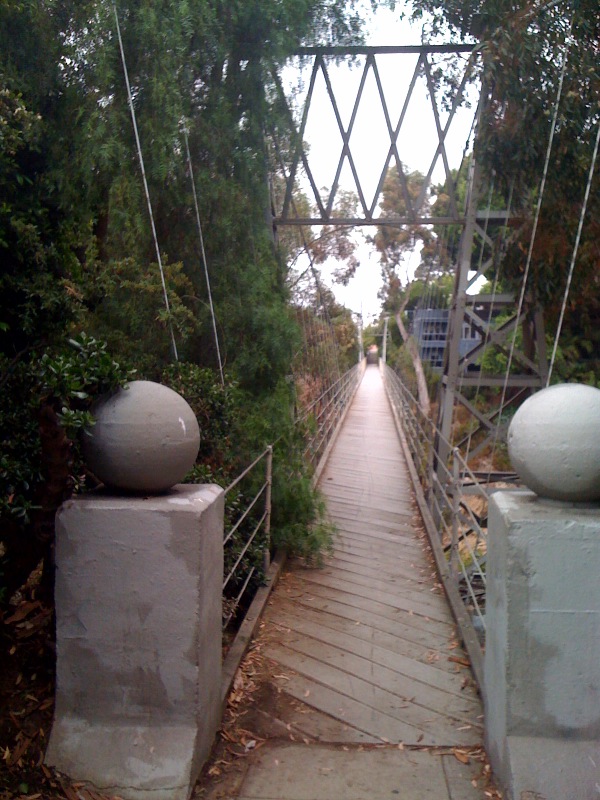
Spruce Street Bridge
Entrance to Spruce Street Suspension Bridge

I first crossed Spruce Street suspension bridge 30 years ago on my lunch hour. It’s located in an older, elegant neighborhood, filled with graceful Victorian and Spanish homes, one of which housed the ad agency where I worked. In the mornings, I would park two or three blocks away and walk to work, passing two large houses full of Hari Krishna people outside gardening or inside chanting.

One day the owner of the agency said he wanted to show me something. While he said he liked my copywriting, he didn’t seem to like me. We often argued. He was happily married and I wasn’t attracted to him, so I don’t think our personality conflict was romantic.

Anyway, there we were one fine Spring day on the wiggly bridge! Laughing, enjoying the view over the canyon and downtown and the ability to get to the other side in a sort of secret way. I thanked him. I think it was his way of saying, “We can work together.” And we did, for two more good years.

Recently I watched a show on local TV about the Spruce Street bridge (“About San Diego” with Ken Kramer). There it was in all its creaking glory, “another story about San Diego,” as Mr. Kramer likes to say.Spruce Street Suspension Bridge
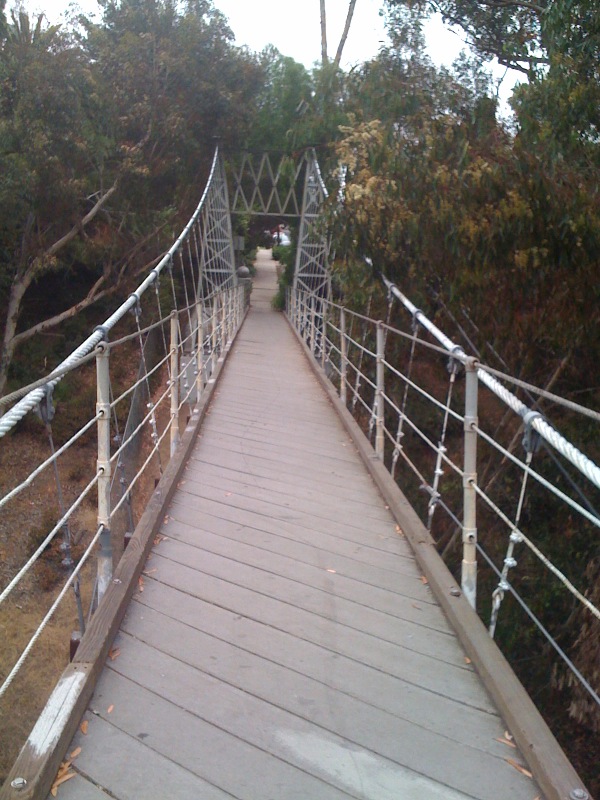
This inspired me to drive down and take photos and another wobbly walk. But in some ways I was already on it. In the middle of moving, I am on my own bridge – suspended, swaying in the air, between one home and another.

Betwixt and Between, that’s me. Not to be confused with Bewitched, Bothered and Bewildered, that state of temporary insanity hardwired into us so we’ll mate and procreate, which I’d actually prefer right now, except I wouldn’t get my packing finished.

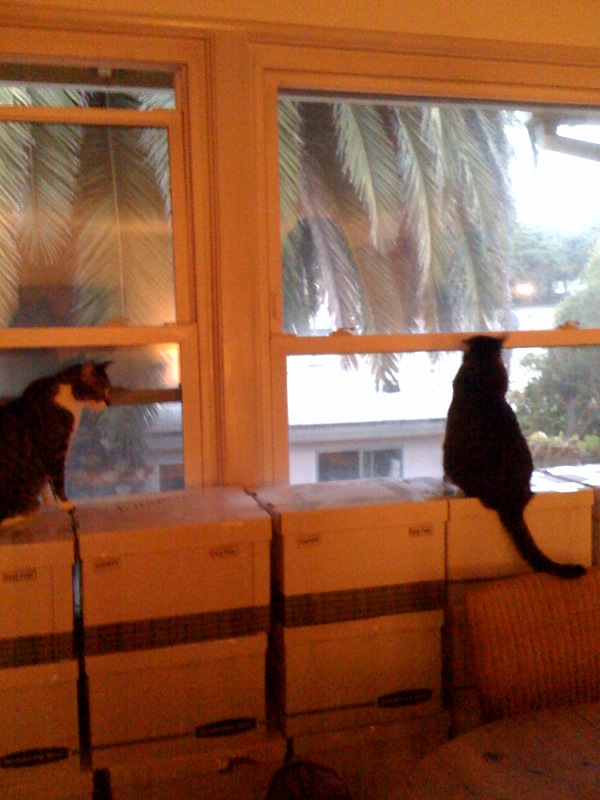
No, I mean the feeling of being neither here nor there, not belonging anywhere. My home of eight years is devoid of life now (except for my suspicious cats) and full of boxes. My new home is having its innards ripped out and is not yet ready to live in. I had planned to leave my current home in a couple of years, to downsize, but a sale and large rent increase put my plans on fast forward and my feet back out onto the streets. Old and new streets. Former neighborhoods. Would I like to be back there again? Exploring new areas. Maybe I should try living over a store or ???
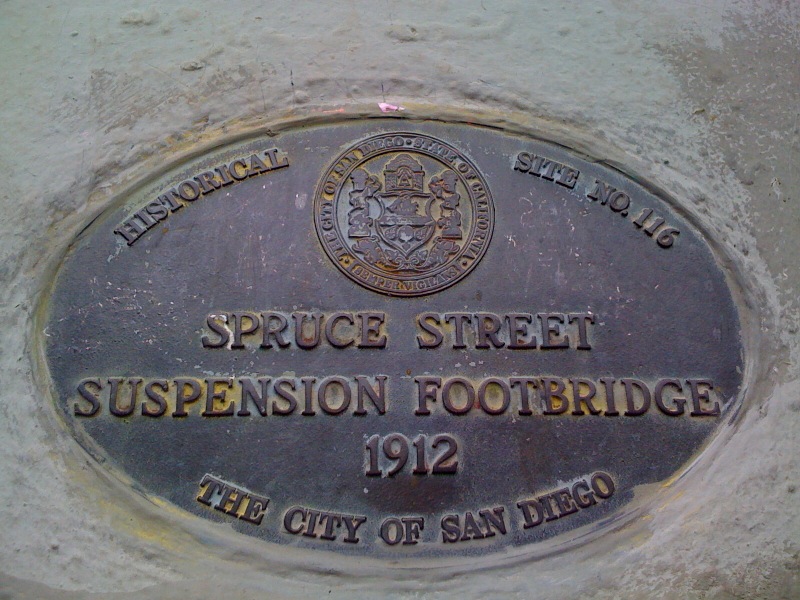
Bridge PlaqueBy luck (and talking to neighbors), I found a new place right around the corner. If it weren’t for a tall condo a few doors down, I could see it from my current window. Straight as the seagulls fly. I don’t know if I will like it. I’ve loved my current space, full of light and looking out over trees and people. I leave it reluctantly, yet I also feel ready to make a new home.

So  here I am, walking the wiggly walk, swaying in the salt air breeze, listening to the coyotes, holding on, no desire to jump, suspended between two parts of the same neighborhood, curious about the other side.
Chronic Packing Syndrome

Most people think of moving as being one of life’s most stressful events – up there with death of a spouse, divorce, loss of a job or limb. But according to one of the official stress-ranking systems (Holmes and Rahe stress scale), moving is actually Number 32 on their list, after “Revision of personal habits” and “Trouble with boss.”

It doesn’t feel that way, now that I’m in the middle of moving! It feels like Number One (and I’ve survived death of family, jobs and marriages).

Why is moving so difficult? I think it’s because it turns our lives inside out and upside down. It’s mentally exhausting. It’s actually more work mentally than physically, although the physical work is bad enough.

Traveling can turn our lives upside down too, requiring constant vigilance, but we know all we have to do is pack our bag and get on a plane or a boat and be home to normal life soon.

With moving, we are packing our bag over and over again and we never seem to get everything in and there is no normal in sight. Our normal routine has been blown out of the water. And if we work, take care of family, exercise (not to mention eat, poop and shower), we know we still have to pack that bag into the wee hours.

Make lists that never end. No sooner do we cross off one item when two more appear. Call mover. Call carpet cleaner, call junk man. Pack all silver. Oops, forgot tarnished family heirlooms and old china. Call cable company. Pack DVD player. Oops, remember to draw diagram of connections before I yank out DVD player, router and modem. Call gas company. Remember to tell them neighbor shares meter so they don’t shut off her power. Order boxes, buy boxes, borrow boxes, drive down alleys and grab boxes in dumpsters. Buy packing tape and markers. Raid the free newspaper stands.Feline packing inspectors

And then the fun begins. Pack, pack, pack! I work into a rhythm. Need music. But I packed my stereo already! The physical work is not too bad. It’s the mental fatigue that sets in. It’s the decisions. Constant decisions.

Do I give away that old heirloom, or carry it with me yet again to loom in the back of a new cupboard? I have the perverse thought that I could bring a box of these family treasures to my sons. They might as well deal with them now as after I’m gone.

Do I sort through my files – business, household, taxes, medical – or just transfer the whole outdated mess to a file box? Do I give away books? I do manage to cull out a few. But what if I really do re-read all the Greek tragedies or Camus and Sartre (in French) or take up juicing again?

How about my grandmother’s cookbooks? Will I ever make Scottish mince again or have an English holiday party? Will I ever use my Spring-themed dishes, crystal glasses and shell napkin rings?

And who will ever read my 20 plus years of journals? Newspaper clips of old stories, frayed college papers and essays?

Feline packerAnd clothes, don’t get me started. Will I ever wear those dresses again I bought for my high school reunion and my son’s wedding (and I can, I haven’t gained weight)? Will I ever totter in the red heels or strappy sandals? Now that I work at home, my usual attire is jeans and a nice top. I could probably survive just fine whittling my closet space down by three quarters. But I don’t dare give away some outfits. Just in case.

I’ve moved many times in my life (at least 12 in 40 years) so I’m far from being a hoarder. I must make from six to ten trips a year to the Good Will, regularly discarding items. I store very little and actually park my car in my garage.

So it’s amazing and appalling to me, when faced with going through it all, how much I do have. And how much work it will take to decide to let it go.

It’s tempting to give it all away and move into a studio.

And maybe that’s what I’ll do. Next time.

While packing my books, I came across this treasure from E.B.White and I’m taking him with me:

For some weeks now I have been engaged in dispersing the contents of this apartment, trying to persuade hundreds of inanimate objects to scatter and leave me alone. It is not a simple matter. I am impressed by the reluctance of one’s worldly goods to go out again into the world. During September, I kept hoping that some morning, as if by magic, all books, pictures, records, chairs, beds, curtains, lamps, china, glass, utensils, keepsakes would drain away from around my feet, like the outgoing tide, leaving me standing silent on a bare beach. But this did not happen. My wife and I diligently sorted and discarded things from day to day, and packed other objects for the movers, but a six-room apartment holds as much paraphernalia as an aircraft carrier. You can whittle away at it, but to empty the place completely take real ingenuity and great staying power.

“Good-Bye to Forty-Eighth Street,” 1957, Essays of E. B. White

The Big To Do

There are certain people who make a big To Do, wherever they go, whatever they do. Even the most mundane tasks become big deals, much more complicated, obstreperous and time-consuming than necessary.

I’ve long been fascinated by this behavior, wondering where it comes from. Is it caused by obsessive-compulsive or attention deficit/hyperactivity disorders? If so, the sufferers have my sympathy. They probably would like to mellow out if they could.

I enjoy doing many tasks as efficiently as I can, and figuring out new and improved methods. Not that I rush, but I don’t like to waste time, especially on unpleasant chores. When I was a teenager, I fell in love with Frank and Lillian Gilbreth, the mother and father efficiency experts in “Cheaper by the Dozen,” a memoir written by two of their children. At that time, I wanted many children and, despite the Gilbreth family efficiency, they seemed to have fun. After having two children (and also realizing the many benefits of birth control), I changed my mind. Family efficiency can work, but is more often a distant ideal, especially at 7 a.m. when you’re rushing out the door and realize one son doesn’t have shoes on and the other has knocked over the fish bowl.

HyperThe two activities where I’ve noticed people can be inefficient is doing laundry at the laundromat and setting up yoga mats. Fortunately, it’s been years since I’ve observed laundromat behavior in person, but I recall it vividly. My own approach was simple: take basket of clothes, detergent, quarters and book or magazine to the laundromat, throw clothes and detergent in washer, read, throw clothes in dryer, read, throw clothes in basket and get the hell out of there. Sort the clothes at home – that part I actually enjoy.

The Big To Doers were in the laundromat before I arrived and after I left. They had brought and lined up several baskets, carts, racks, hangers, boxes and bottles of detergent, bleach, softeners and other additives. They never sat down, even for a second. Their complicated routine went something like this: Carefully pre-sort, turning some items inside out. Pop a few in one washer, a few in another, pull some out, start a dryer, then back to another washer. Pull clothes out of dryer, hang some up, fold some, back to washer, back to dryer, back and forth, constant motion, washer woman or man whirling dervish. I never was able to figure out what they were doing, or why. Maybe they have 12 children. Maybe it’s the highlight of their day. Maybe they just enjoy making a simple task as complicated as possible.

The Big To DoThe other Big To Do I find fascinating is the setting up/setting down of the yoga mat that some yogis elevate to a ritual before class. Most of us walk in, bend or kneel down, unroll our mats and lie or sit down. Sometimes we walk over to the prop wall to get a cushion or a strap or to the cubbyhole wall to store a wallet or purse.

The show-offs walk in (or sometimes rush in late), unfurl their mat in the air and drop it on the floor. This makes a loud noise and sends a whoosh of air out over those of us already on the floor. They then unfurl a second cloth mat over the first mat. Because these slip, spray bottles are provided to dampen them with water. That’s right – spritz, spritz, spritz. Then the lining up begins, one mat over the other, and both in line with the lines on the floor. Then several trips for props and blankets. But not the cubbyholes. No, they prefer placing water bottles, coffee, keys, wallet, jackets, cell phones around their mat on the floor.

One man comes in before class fully dressed in long pants and a jacket and by the end of class, he has stripped down to shorts and tank top, his long pants and jacket in a heap behind him. Sometimes, after all this, a person will decide the space is not right and move – and start the yoga mat routine all over again! Every few months this behavior crescendos and “Yoga Etiquette” guidelines are posted inside the bathroom stalls to remind us. But those of us who set up quietly and quickly don’t need reminding and those who don’t don’t think guidelines apply to them.

To do or not to do. For them, it’s not even a question.

Window Shopping Other Lives

For me, shopping is like meditation. I prefer to do it alone. If someone is next to me, I want them to be quiet, not asking me if I’m visualizing the tropical beach or if I really need that Hawaiian shirt. The only person I can shop with successfully is my sister. Cut from the same fabric, we are able to go with the flow compatibly, wherever the shopping zone might be. The right combination of closeness when we need it or distance when we need the quiet space to contemplate.

What is it we are contemplating? Like meditation, shopping is a temporary escape from a life where I’ve always worked hard and had a lot of responsibilities. I feel the need to say that, because I know shopping sounds so frivolous compared to activities such as finding a cure for cancer or ladling soup in the ghetto kitchen. Like meditation, if undertaken for short, focused periods, it can enhance our lives. It’s a creative way to contemplate all the pieces of my life, how they might better fit together or come alive with something new … or should I throw them all away and start over? It’s a way to imagine myself in a whole new life even, at least for a couple of hours.

window shoppingInstead of a down-to-earth, work-at-home beach bum who wears jeans most of the time, I can be a business woman, but hipper; a bohemian poet; a punk rock rebel; a tasteful sex bomb; or a sleek athlete. I try these possible lives on in my mind, not in the dressing room, where my dream would be instantly and cruelly shattered. No, no dressing rooms with their three-dimensional mirrors and light blasted directly from the sun. The point of contemplative window shopping is to imagine possibilities and weave their spirit back into my own life. Maybe instead of dressing like a rock star, I just need to listen to music more often or take guitar lessons?

This type of meditative shopping doesn’t have to be just for clothes either. It works with home décor, books, cosmetics, gifts, and many other items. (Maybe that red vase would zap up the beige living room? Maybe I should move to a tropical tree house on the beach?) And it doesn’t have to be just for women.

While most men do not seem to like shopping for clothes or gift items, I’ve seen them disappear for hours in hardware, gizmo-tech, and auto supply stores. They may go in for a computer cable or transmission fluid, but I’m sure it crosses their minds while trolling the aisles of gadgets that the new $5,000 home theater system would fit in the family room, or that the Italian leather key ring would look good dangling from a Ferrari ignition. Maybe they would look good cruising the Amalfi coast? With a hot Italian, of course.

Oh, the possibilities for all of us as we browse the Other Lives selections. We may come home with a small item or two, but that is not the main reason for the shopping trip. Money cannot buy what we bring home: a new way of looking at our lives, some vision that beckons us forward and yet still casts an appreciative glow on what we already have.Shopping at Bloomies

If we’re lucky enough to have a good relationship, we can keep it that way by never shopping together. Unless it’s an emergency, like the couch exploded or you ran out of beer. Even then, it’s better if just one goes. Almost every time I am out shopping – happily alone – I overhear an unhappy couple who have ignored this guideline. The man, often older and newly retired with nothing better to do than bug his wife, is reminding her that she already has three sweaters in that color. Or that she is not the expert on couch construction she thinks she is. I want to pat her on the shoulder and say, “Next time, leave him at home on the remains of the couch.” Or sometimes I see a cute young guy sitting patiently on a couch outside a dressing room. “Hi,” I want to say, “did you know there’s a great hardware store next door? It has everything you can imagine – and more.”

The Royal Gloom and Bloom

June Gloom we call it along the coast – the marine layer that hangs over us, dulling scenery and spirits for almost all of this month’s 30 days. Even worse, it drags directly behind May Gray, thus insuring a double dose of semi-drizzle and we are not sure if spring is really happening. It’s also hard to know what to wear during this gray and gloomy time. The sky is overcast and the air makes us shiver, so we put on a jacket and a scarf and then when we drive a mile inland, we roast. Away from the coast, people are lightheartedly skipping around in sandals and shorts or sundresses.

It is Spring, of course, but evolving slowly, not at all like springs in colder climates where there is snow and then bright pokes of green and sudden riots of color. When my family moved here from Montreal, gardens were thriving and it was warm and sunny back home. In our new home, my sister and I could hardly wait to run down to the beach. We froze. It was May. There was no golden sun in our California at all.

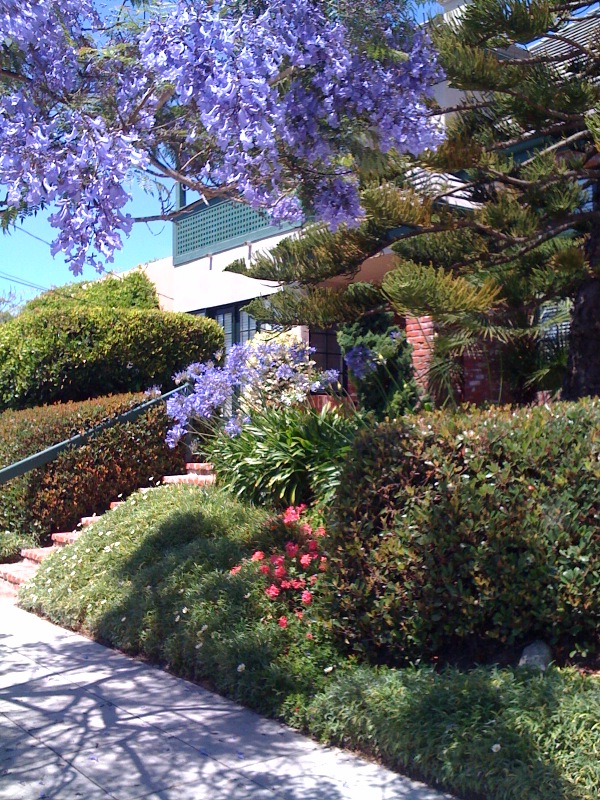
But now that I’ve lived through many such Mays, I’ve realized that there is a purple lining in our silver skies as our coastal spring unfolds, a royal glow as purple blooms everywhere. Jacaranda trees arching over the sidewalks. Agapanthus, lantana, princess flowers poking out from gardens. Morning glories climbing fences. Sea lavender standing guard over the ocean. Sage, daisies and mountain lilacs cloaking the hillsides.Jacaranda and agapanthus

The Jacaranda tree is May/June’s crowning glory and San Diego’s official urban tree. It’s a sub-tropical tree native to South America and was imported to San Diego and Los Angeles in the early 1900s by Kate Sessions, a California horticulturalist and landscape architect, also known as the mother of Balboa Park. The jacaranda also blooms in the fall, but not with the same periwinkle blue-purple brilliance that it does in the spring. The branches bend and bow over our sidewalks, dropping little trumpet-shaped blossoms. I’ll take walking on this magical purple carpet any day over a red carpet. And just as the purple jacaranda canopy fades, it’s July and the blue of the sky takes over.

Another purple flower that blooms here in May and June is the agapanthus. They seem to appear suddenly out of nowhere, big, round, purple balls poking scepter-like toward us from front lawns. (There are white agapanthus too, but they are outnumbered by the purple ones.) The agapanthus are originally from South Africa and are also known as lily of the Nile. They grow around the world, even in gray England, where they are called the African lily and mentioned in a Harry Potter book. It’s possible to see a royal connection, resembling as they do staffs of pharaohs and monarchs. They point the way to victory – the clearing of our skies.Morning glory

In Southern California, and especially San Diego, we have one of the best climates in the world. It’s usually never too hot or too cold, so you’d think we wouldn’t complain about the weather. But of course we do, especially by the ocean during spring when we crave some tantalizing, tangible evidence that summer is around the corner. When will this gloom and doom lift? Until it does, it helps to know that the hazy gray sky has a touch of royalty, in the richest sense of the word.

Beam Us Up

My dad used to tell us that we’d be able to teletransport ourselves one day. I’m not sure where he got the idea, but he was an electrical engineer and interested in electric charges, currents and potential. This was a good 10 years before Star Trek’s Captain Kirk ordered Scotty, the chief engineer, to “beam us up.”

Unfortunately, my dad didn’t live long enough to see much of the show. He died of a heart attack at age 52 a year after it aired in the late sixties, and two months before the first heart transplant. My own heart aches even more now, 40 years later, fully comprehending just how young he was, and how much he missed.

But I do remember he enjoyed Star Trek and Scotty, being Scottish himself. My mother was in love with Captain Kirk, William Shatner, and never tired of telling us that he went to her high school in Montreal.

Dad was a shy man, a homebody, and he loved nothing better than tinkering, working with electronics and wood. He was a neat freak, liked everything in its place and neighbors used to kid that all his screws were never loose, but immaculately lined up and labeled in little jars in our garage.Dad

So it’s remarkable – a testament to his quiet courage – that he uprooted us all from French Canada and beamed us out to the Beach Boys and surfers of Manhattan Beach. Not happy with his work in colder climes, he sought more in the Golden State. And he blossomed in the sun, becoming a professional tinkerer, researcher and inventor for a big electronics company.

During those years, as I developed an interest in journalism, he suggested I become a technical writer. “Oh no, boring!” I said. I could barely stand his algebra lectures, which I needed to keep my B grades in math classes. So I ignored his advice and earned a degree in journalism.

My first writing jobs, after my dad died, were in advertising copywriting and newspaper journalism. I loved the work, but struggled on slave wages as a single mother to keep afloat. My first newspaper job was as a feature writer for the community newspaper in Palos Verdes, a wealthy area. Here I was living on a paltry salary covering social events, interviewing women at tea parties in pearls and cashmere sweaters, who were usually raising money for poor people.

After several job changes and layoffs, I met an editor who worked for Epson, the printer company. They were looking for writers and loved journalists because we could write so clearly. So I went over and met the boss and was hired. The next thing I knew I was sitting in a cubicle with a computer and a printer – and with no idea how to turn them on, let alone use them, or write about them. Now where was dad when I needed him?

The work was not as exciting as journalism, but I quadrupled my salary overnight! And all these odd engineers seemed somehow familiar. I felt transported back to the times when dad took me with him to monitor radar stations and I examined the knobs and dials (he was finishing college and we lived on a converted air force base outside Montreal, a division of McGill University). Or to the times I sat beside him while he tapped out the Morse Code on his ham radio to someone in Alaska. Wow! Alaska!Dad and Me

Since my dad’s death, I’ve only dreamt of him once. He and I were walking on a beach, arms around each other, and we came to a dark forest. “I have to go another way,” he said “and you have to go into the forest alone, but you’ll be fine.” And he was mostly right.

Sometimes I wish he could beam himself into our present. So much has happened in his electronic world! From vacuum tubes to tiny, tiny chips. From neighborhood party lines to worldwide messages. My sister and I talk about this often. She has worked successfully with computers too, as a network analyst and web designer. We’d love to see his big hazel eyes when we beamed him an email or text message or floated his photo on a screen halfway around the world. “Beam us up,” he’d say.

Splish Splash

splish splash
I was taking a bath
long about a Saturday night

Rub dub
 Just relaxin in the tub
 Thinkin everything was alright

Bobby Darin

When trying or learning something new, is it better to dive in or to wade in gradually? Or to do something in between, say quickly jump off the side ladder into the middle of the pool? I think all can work. It depends on who we are, where we are and what we’re doing on any given day.

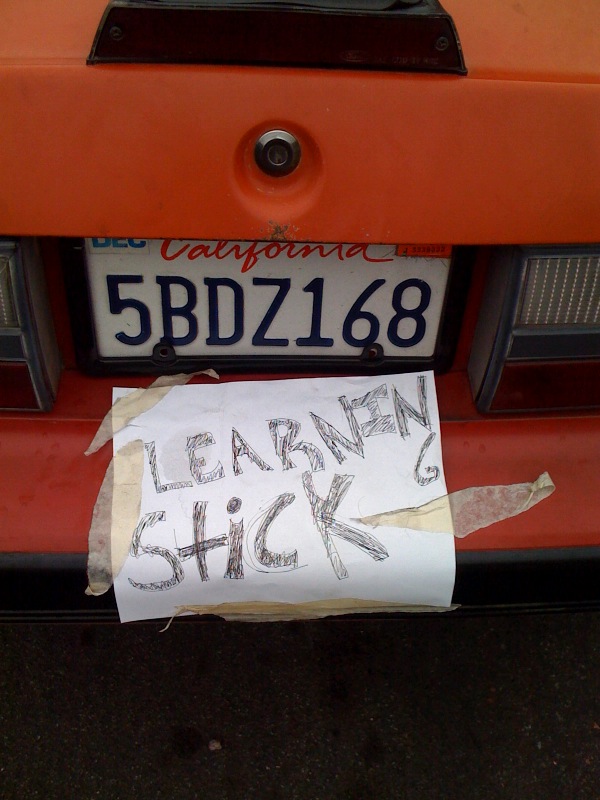
For example, I admire the person who created this makeshift bumper sticker – “Learning Stick.” He or she seems to be saying, “I’m in the middle of the road here, in the middle of learning. I’m taking chances but I’m giving you a warning, creating a safe zone, hopefully one without your middle finger.”Stick Shift

I learned to drive a stick shift in an in-between way too. Back in the early 70s, I fell in love with the sporty new Mercury Capri when I needed a new car. It only came with a manual transmission – and I didn’t know how to drive one. I bought the car anyway and had a girlfriend drive it home. She stayed the night and the next morning, a Saturday, we got up at 5 a.m. for my stick shift driving lesson. Fortunately my friend had a calm nature and a good sense of humor and it was dark and quiet except for my little car’s screeching brakes and howling gears.

On Sunday morning I got up early by myself for my first solo stick shift drive, lurching around the neighborhood. I dreaded Monday morning and my 10-mile drive to work. It was awful. I lurched and stalled my whole way there and then spent the work day dreading my return trip home. It was just as awful – lots of traffic, honking, grinding of teeth and gears and cursing. Each day got better, however, and finally the stick shift became second nature and for many years I loved it and went on to own more sports cars with manual transmissions.

Yes, this middle ground works for me. It usually includes a helping hand, literally or figurative. For example, learning to swim. My parents jumped off a dock and encouraged me to paddle in clear lake water between them. Then my grandfather held me up on my back in the Atlantic waters off Cape Cod. “The salt water keeps you floating” he said, gently removing his hand, and before I knew it, I was swimming on my own. These helping hands can take many forms – friends, family, teachers, counselors, books, classes, groups.

Of course, what lurks on the unknown road or in the deep, dark waters is fear. Anything new worth doing is scary.” Many books have been written to help us with this, including the classic “Feel the Fear and Do It Anyway,” by Susan Jeffers. If we want to get anywhere new, challenge ourselves, we have to acknowledge our fear and figure out a way to deal with it while still moving forward.splish splash

For some of us, or for certain goals, this means taking tiny steps into the shallow waters until we are afloat. For others, it means plunging right in and hoping the water does not knock us out. For me, it’s often a combination of these – thinking for awhile and grappling with fear until it seems silly to sit in the toddler pool and better to get it the hell over with and jump in over my head. And hope there is a party goin on …

I was splishin and a splashin
rollin and a strollin
movin and a groovin
realin with the feelin

Splishin and a splashin
on a Saturday night

Fear of Going Mad While Flying

“I feel like shrieking,” I said to the woman next to me on the airplane. She was squirming even more than I was, squished in between me at the window and her husband on the aisle. “But, don’t worry, I won’t.”

We were three hours into our 5½-hour flight, which was an hour late taking off. We sat at the gate and then on the rainy runway at JFK Airport behind dozens of other jets before we were cleared for takeoff. The pilot kept saying, “Another 20 minutes, another 20 minutes …” while cell phones came out and people made calls to change their pick-up times.

crowdsShe and I had exhausted almost all activities: reading, napping, checking phones and computers, looking out the window, watching a movie (she with headphones, me without, but I was desperate), getting up and bumping down the aisle to the teeny bathroom, drinking, eating.

Eating used to take more time on these flights. Now that many airlines no longer serve free meals, at least in less than first class, there is not the fun of opening the little packages and trying to figure out what the globs are and gobbling them anyway. On my flight going east a few days earlier, I didn’t catch the flight attendant in time to order anything. (It takes them forever to get down the aisle, but if you look away for a few seconds, they are gone.) And my two connecting flights were so close together I didn’t have time to pick up anything at the airport, like a $10 granola bar.

This time, I was smarter and quicker in the airplane and I scored a $10 turkey sandwich with potato chips. I hadn’t eaten in about 12 hours and it was one of the best sandwiches I’ve ever tasted in my life. I tried not to wolf it down, instead savoring every bite for the taste … and the filling of time.

The woman next to me whipped out something from her tote that looked and smelled delicious and I wondered where she got it, but I kept quiet, licking the salt and potato chip crumbs from the bag. Sometimes I prefer not to talk to my seatmates. Suffering in silence beats an onslaught of personal drama or incompatible political or religious philosophies. It’s the luck of the draw – or the airline’s software program.

I once sat next to The Bug Man, as his hat said. I asked what he did, thinking he might be an exterminator. Turns out he was an entomologist (bug scientist) and a well-known bug wrangler who works in Hollywood overseeing movies with bugs and insects (such as “Arachnophobia”). He was interesting and single! (But with rooms full of bugs at home, he said, not appealing to me, a bug phobe.) Later, I saw him interviewed on television and wondered why he didn’t fly first class.

Joking with the woman next to me broke the silence and we soon were off and running (mentally, not physically), sharing our love of yoga and how much we were looking forward to getting back to it. She had been away for five weeks, visiting her son in Spain and her daughter in New York. We discussed our work, children, cats. It was a pleasant conversation and before I knew it, the San Diego skyline appeared underneath us and we were swooping in for a landing.flying object

I’ve always loved flying, especially the take-offs and landings. I’ve never had a fear of flying, but now I’m starting to dread it. In the past, I’ve flown to Australia and Europe with less discomfort and inconvenience than I’ve endured recently on shorter trips. These have included cancelled flights, delayed flights, arbitrarily reassigned seats and airport connections and lost luggage. And it gets worse each year as the airlines think of new ways to torture us.

If the airlines are cutting back to be competitive, why aren’t they offering better service, not worse? Fewer flights perhaps, but at least on time and maybe a little meal?

I cannot image a restaurant or store doing business this way and keeping customers. “You have a reservation for 7? Too bad. We won’t be serving dinner until 8:30. You wanted the booth by the window? Too bad. All we have left is the table by the back wall. You want to leave? Too bad. We locked the door and you can’t leave until we say so.”

How many of us would come back? If we want to travel quickly, do we have a choice? Would a covered wagon be better? I’m beginning to think so. There might by dysentery and wild Indians, but at least we could lie down and get comfortable for awhile, gnaw on buffalo jerky.


When a Friendship Dies, Do We?

walkingSomething weird has happened in the last year with a former friend – a yoga and walking buddy and neighbor from down the street. We pass on the street walking. I am usually alone. She is usually with one or two friends, taking up the whole sidewalk. She’s easy to spot because she has a distinctive walk – a sort of lope that’s all over the place and odd for such a small woman. She also wears a distinctive outfit, the same one no matter the weather. An expensive, long-sleeved track suit. And from the neck up, a large flappy, floppy hat with fabric like a veil coming down on either side and in back, some hanging free and some tied under her chin to keep it on her head. The result is that she looks like a beekeeper.

After not seeing her for more than a year (she stopped going to yoga and we couldn’t seem to find convenient times to walk), I recognize the loping beekeeper from a distance and smile as we pass on the sidewalk. She keeps looking at and talking with her friends and ignores me. Maybe she didn’t see me, I thought. But then it happens again, and again. The second time we pass, I look right at her, catch her eye briefly and say hi. No response. Nothing. Nada. It’s as if I wasn’t there. I felt cold and hot and then empty. A shiver of shock, a blast of anger, tepid with sadness.

My god, what are we? Seventh graders?

Since then, it’s happened several more times. I won’t see her for weeks, then I’ll see her two or three times in a few days and she pretends I don’t exist. One day I can’t help myself and yell out, “You are being so childish!” I hear her gasp and then her friends, gasp, gasp. It takes me straight back to that childhood summer when my best friend went off to Lake Ontario to visit her grandmother and the other neighborhood girls decided I was worse than a worm.wrong way

I’ve tried to figure out what I may have said or done to this former friend to warrant this treatment. We enjoyed regular walking and talking for a couple of years when we met in yoga class and realized we lived on the same street. We had several things in common – close in age, both divorced with grown children, both self-supporting. I enjoyed our conversations and appreciated her words of support when my mother died. She even remembered the anniversary of my mother’s death a year later. We didn’t always agree on everything, but who does?

I think it had to do with the handyman. I needed one, asked for her recommendation. My luck so far had not been good with handymen. One young guy I hired at the local hardware store failed to show up two or three times in a row because he “slept in.” Another I found online said he was new to the profession after being laid off. It took him two hours to attach a paper towel holder, which was crooked and kept the cupboard door from closing. A third one I ran into around the corner where he was working in a neighbor’s garage. He was nice-looking, youngish, new to the area and eagerly came over to look at my projects. He mistook my friendliness for something else and the next morning at 6 a.m. was sending me text messages that make me want to laugh, cry and curse. Let’s just say his idea of putting his tools to use didn’t involve the nails and hammer he was using around the corner. After two days of this, I texted back that my son was coming to stay in my place while I was away for a long time far away and that he’d have his pit bull with him.

So, I asked my walking friend for a recommendation and she gave me the name of a man she’d been using for years, said he was great. I called him. He was gruff and uninterested in talking. “You do know it’s Sunday, don’t you? Call me back tomorrow and let me know what you need.”

Why did he answer the phone on Sunday if he didn’t want to talk? Maybe because of my recent experiences, I decided I didn’t have the patience for yet another strange handyman and told my friend this when she asked if I’d called him. She was shocked. “Oh, he has a heart of gold,” she said. “He’s the only person who works on my house I trust with a key. And my friend (one of the gaspers) has used him for more than 25 years. I guess I’m just used to his gruffness.”

So, was it the handyman that was the friendship breaker? I have thought of emailing my former friend, but I doubt she would answer. It is frustrating not to know. Not only is it hurtful, it defies all reason. I suspect she decided we didn’t have enough in common to continue a friendship. Even if the handyman were not an issue, something else would be. But even so, even if we realize we are not friends with someone, does that mean we ignore them, pretend they are dead? Perhaps if I had done something offensive like sleep with her ex-husband …

It is even more frustrating with her because she is a psychologist, very proud of her PhD. She counsels people who want to improve their behavior and their lives.

Changing Lanes

To my friends who are changing lanes. You know who you are! I wish you the best of luck and salute your courage.

It can be pretty scary sometimes changing lanes on the freeway, or any busy road. Here we are, hurtling along at 60, 70 or 80 miles per hour, protected only by thin pieces of metal – and now we have to speed up or slow down and look around 360 degrees for the other hurtling objects, gauging the best instant to make the move.

Thankfully I’m not thinking this every time I drive or I’d never go anywhere. Like many, I listen to music and go with the flow on auto pilot. I usually stick to the middle lanes, midway between the fast and the slow. The only time I drove 90 miles per hour in the express lane a family member was on his deathbed and the only time I stayed at 40 mph in the slow lane I was stuck in second gear in my old sports car.

Yes, the middle lanes have suited me, both on the road and in life. I don’t like to hurry or multi-task and am more of a Type B than a Type A fast track person. The three years I spent working full-time, finishing college and caring for my two sons were the closest I came to the fast track and I was glad when they were behind me. However, I do like to move along, reach real or imagined destinations, and in the middle lanes I can avoid running into those slow lane putt putts making tentative entrances or looking for exits.

But recently the slow lane has started to appeal to me. Since leaving my demanding technical writing job three years ago and working as a freelancer, I haven’t had to work as much, and more important, I haven’t wanted to work as much. Gradually, I’ve been drifting from the next-to-the-fast middle lane to the next-to-the-slow middle lane – and I’m starting to eye those exits from the slow lane perspective. Maybe I’d like to get off the freeway altogether and explore the coast highways and byways?

Maybe it’s time to find other ways to work, in addition to or in place of writing for a living, writing what other people want? Maybe I could join the artists and explorers who are taking the time to feel the ground underneath their feet and smell the ocean, desert, and mountain air? Maybe reaching external destinations is no longer required, at least not all the time?

And so, here I am, easing into the slow lane, edging back into the middle. Riding between the lanes like a motorcyclist and just as exposed.

Recently I pulled off for a couple of hours and visited an old friend. A year ago she left her high-powered marketing job and immediately enrolled in culinary school with the idea of becoming a chef. For several months, she stuck to a grueling schedule. When she finished, she realized she didn’t want to be a chef at all – a least not professionally. She loves to cook for friends and family, but she didn’t want to work for anyone!smell the roses

So, in addition to exploring famer’s markets, she adopted a dog, rescued from the streets, who gets along well with her cats, and requires a lot of walking. She also tends a couple of rose gardens in a public park. She gave me a tour, naming each rose bush and explaining its history.

“I’m loving all this, but I wonder if it’s really enough?” she said.

We laughed and laughed at her dog’s antics. With broken legs in his past, he hates getting in and out of the car. With a tender back, she hates the wrestling match it requires to get him to move.

Once back at her place, she clipped me some red roses from her own garden. I got back on the road and headed home, in the slow lane. The smell of the roses filled my living room for many slower-paced days. It felt like more than enough to me.