I just got yelled at in a parking lot for taking too long to push my cart. The woman (not young or old) in a big white van shouted, “Get a move on!”
It’s true, I had a momentary mind lapse in front of PetSmart, my cart full of a heavy box of litter and canned food, as I watched her coming along. I couldn’t tell if she was going to stop and she didn’t seem to be slowing down, so I paused. Then for a few seconds I turned my head in the other direction to look at some new construction. When I turned back, she had sort of stopped, that is, the van was inching along. That’s when she yelled.
I pushed my cart in front of her, willing myself to remain calm and not flip her the finger. I didn’t really feel angry. I considered blowing her a kiss and shouting, “Mellow out honey buns.” But I did feel hurt and violated and a semi-humorous albeit sarcastic response was too nice for her. By the time I got to my car, I wanted to cry.
I watched the van charge ahead toward the exit, where she ran into the construction blocking her way out. She then had to zig zag back through the parking lot and through a gas station to find another driveway into the main street.
Sadly, I’m used to the rudeness. In La Jolla, mothers in big SUVS texting and cutting other cars off. Businessmen in black Mercedes not stopping in intersections. In Pacific Beach, the impatience of many young people, music booming, trucks bearing down.
But this was the first time someone actually yelled.
Admittedly, there have been times when I’ve felt impatient crawling through a parking lot behind a group of people not paying attention. Often the same mothers or twenty-somethings who tailgate or rush around on the road but amble, take … their … sweet … time, four abreast, on the sidewalk or in the parking lot aisle.
But I would not assault them with words anymore than I would with a gun.
Two extra minutes is not going to make a difference in my life. Barring emergencies, does it in anyone’s?
Why did this woman, not young or old, in the huge van, feel the need to yell?
Her words weighed on my slightly stooping shoulders the rest of the day.
What if I were really old and slow? That day is closer than I care to admit and it makes me sad, really sad, to think further insults await on the road ahead.
Reading Carolyn See, I’m sixteen again, flying with my girlfriends up Pacific Coast Highway. We are good students, serious girls, honors English, we have standards, but on Fridays after school, we are free. Bouncing along in a finned Ford or Buick, blasting our music, shouting into the salty wind to anyone who will listen, happy to be cruising to the outer limits of vast LA.
Carolyn was like that. She captured all the broken dreams and sun-baked inhabitants of an indefinable city without driving off the edge, without abandoning the zany sense that all this is nuts, but aren’t we having a great time? Her writing in all its forms – novels, memoir, book reviews – always grasped the importance of a subject, but without a pompous PhD voice. No dusty academia for her, even though she graced the halls of respected universities.
Even writing about sadness and terror – her screwed-up parents, lives, loves and worlds lost – she managed to reveal all through a lens of compassion and humor.
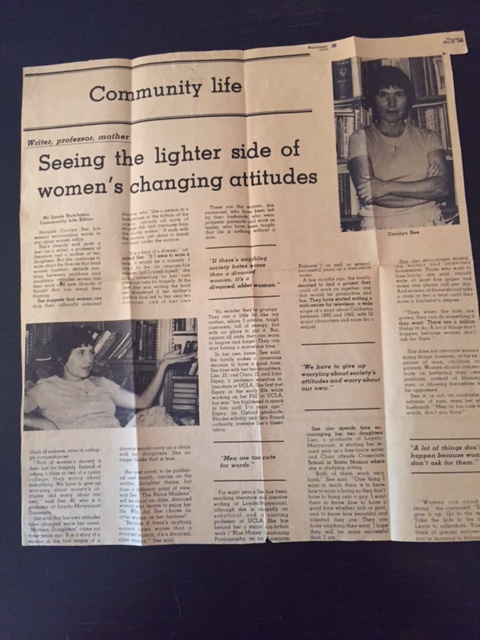
I knew none of this in 1980 when I went to interview her. I didn’t know who she was.
I read about her novel “Mothers, Daughters” and decided it would make a nice story for Mother’s Day. As the new feature editor of the Culver City News, it was my job to build up the Community Life section of the paper.
I reached Carolyn in her office at UCLA. “Sure, I’d love to talk to you,” she said. “Come on over!”
And so I did, little reporter notebook in hand, camera in my purse. She greeted me warmly and escorted me into her office with high windows. Unlike many people being interviewed, she seemed at ease. I liked her lack of pretention.
I soon learned that her latest novel was not a tribute to sweet mothers. No, it was a dark story about a sad woman going through a divorce. This launched us into a discussion of divorce (we had both gone through two), single motherhood (she had two daughters and I two sons), and changing attitudes. She thought it was important for women to learn to take care of themselves and give up their “lust for tragedy.”
“If I were to write it today, it would be a comedy,” said Carolyn.
In her next novel, “Rhine Maidens,” which came out the following month, her older, divorced woman character learns to enjoy life – while still appreciating children and men. “Men are too cute for words, don’t you think?”
After jotting down all I could capture, I took Carolyn’s picture, assumed I’d be leaving.
“Oh no, we’re taking you to lunch in the faculty lounge. I want you to meet my boyfriend and my daughter. We’re working on a soap opera mini-series for TV.”
And so I met her distinguished man friend John Espey and her daughter Lisa See and my story took on more layers and flavors. An anthropology professor sat with us for awhile. Carolyn announced she was anxious to get home to see how the wetbacks she hired to work in her yard were doing. “Carolyn!” the professor admonished her. But I think she knew Carolyn spoke from irreverently dark humor, not meanness.
I learned that Carolyn had first met John in the early 1960s. An Oxford graduate, writer and UCLA English professor 21 years her senior, he oversaw her dissertation. “But I was too frightened to speak to him until 5 ½ years ago,” she admitted. They were together for more than 25 years.
I enjoyed writing the story and Carolyn liked it too.
She and her daughter thought it was horrible I was stuck in an office and had to write for others. I often thought of Carolyn in the years that followed, especially after I moved from journalism into technical writing, no longer writing about people, but about machines and their software. Even though my bank account grew, my soul shriveled in grey cubicles; by comparison, noisy news rooms didn’t seem so bad.
The trio I met that day in May 36 years ago published two novels and a non-fiction book as Monica Highland. Lisa See is a successful novelist.
In the following years, I ran into Carolyn a few times at readings. I read almost everything she wrote, cried over her tribute to John when he died in 2000, her grappling with grief while sitting in The Self-Realization Fellowship Lake Shrine in Pacific Palisades. She wrote also about her failing eyesight and I could not imagine an unseeing See.
My own writing alternated between floods and droughts and I eagerly grabbed her book, “Making a Literary Life: Advice for Writers and Other Dreamers,” when it appeared in 2002. She recommends writing a thousand words a day and “charming notes” of appreciation five days a week to other writers, journalists, artists. I was too lacking in confidence to follow her charming note advice, especially during drought seasons. But I had a list started, and she was the first one on it.
So I’m writing it now, my thank you letter to Carolyn. I’m sorry I waited so long.
What is it that compels people to offer unsolicited advice? I’ve written about this before but it’s worth writing some more. Unless I ask for it, I don’t like receiving advice. Most of my friends and family know this about me, so when I do get unasked-for advice, it’s from people who don’t know me well.
Recently, for example, a new woman in yoga overheard me explaining to the teacher why I shouldn’t be pushed on the lower spine (the beginnings of bone loss). I already had a funny feeling about this woman, since I’d heard her advising others and I could tell she was listening in. Sure enough, she moves in closer and starts to tell me about a magic herb cure. I cut her off, telling her I wasn’t into herbs and preferred treatments that were tested and proven safe and effective. I then walked out.
In retrospect, I wish I had calmly replied, “I am satisfied with my current treatment.” Let it go at that. The incident made me think about advice giving after a long period of being blissfully free on the receiving end. I even Googled it.
According to what I read (admittedly not totally scientific), most people do NOT like unsolicited advice. So I am not alone here. Only a handful said things like, “I am always learning so I welcome new information” or “The universe is bringing me what I need.” Whatever. If they are perpetually 15 or grew up in a cave, I understand.
It takes awhile to get our bearings in life, to figure out what makes us happy, healthy, what’s important, what work we enjoy, how to take care of ourselves. Some figure it out sooner and give out vibes – no advice needed! (Or maybe they become advice givers, personally or professionally.) Some, me included, are late bloomers and look to many sources for learning – exercise, discussion and support groups, therapy, retreats, reading, fellow travelers, pills, martinis.
I think during this blooming time, which coincided with the colorful, experimental seventies, I listened to a lot of advice! I deliberately put myself in the way of know-it-alls. Dated and even married men who recommended careers, writing styles, how I should handle my sons. Hung out with a few girlfriends who insisted I would benefit from Buddhism or EST being louder. I willingly embraced nuggets of advice, at least long enough to examine them and decide if they made sense to me.
Then I reached a saturation point. Enough already! I gradually realized I’m living the way I want to and feel content most of the time. I like the word contentment better than happiness, since it seems more realistically human, embracing self-acceptance and gratitude, even if we have days of sadness, regret or frustration. Yes, I may need a shoulder to cry on sometimes, or a sympathetic ear, but not necessarily a bunch of babbling “shoulds.”
Does this need to tell others what to do come from a good place? A desire to help a friend? Perhaps. But I also think it comes from a need to alleviate anxiety. To solve problems and thus feel in control. Men do it because they are brought up to be take-charge protectors. However, women do it too.
And sometimes those who offer advice do so because they don’t want to look inward. Easier to solve the problems of others than their own. I admit I have done this mentally, more in the past. Getting older has helped me focus on what I can do with my remaining time and less on self-righteously planning what my friends should be doing. So I try very hard not to offer advice and to ask first if I think of an idea.
And thus my annoyance, after years of being a patient listener, on the receiving end of so much blather. Shut up, already. There is room for no more. If I need help expanding my mind or improving my life, I’ll ask, but in all honesty I prefer to learn on my own.
What I really wanted to ask that woman was, “Why do you think I need medical advice? Are you a medical doctor? Do I have a sign on me that says, Know nothing. Soliciting your infinite wisdom?”
This morning as I left yoga she was busy advising the teacher on how to teach a pose.
It’s a toss-up, literally and figuratively. My three cats suffer terror for about an hour during the hunt and toss into carrier phase, the yowling drive there, the visit indignities (being pried or dumped out of carriers and having orifices probed), then the howling return drive. Once we are home, they are upset for another few hours, hissing at each other and growling at me. By the end of the day, all is forgiven and forgotten.
I don’t enjoy any of this either, but I am more upset before than during. In fact, I start worrying the night before as I carefully bring out the carriers and line them up on my office floor. What if I can’t catch them all? What if one of them runs and hides in a place where I can’t reach (like under my bed)? What if one of them bites or scratches me and I die of an infection? Why don’t I have a boyfriend or husband right now? Why the hell did I get three cats?
A few years ago I was taking care of an outdoor cat I had to take to the vet for a fight wound. Even with a neighbor’s help, I couldn’t hold Buster firmly enough to stuff him into the carrier. He was a sweet cat who belonged the neighborhood but there was no way he was going to endure being taken away. I was already running late for the appointment and finally called in desperation. The vet tech suggested we descend on poor Buster with a large towel or blanket. “That will calm him down.” It worked but I’m not sure I could have done it alone and poor Buster was suffocating in that writhing mass of blanket.
So, for my three, Dewey, Lily and Zoe, this would be my last choice. I reviewed some advice online. I was a little out of practice, since I hadn’t taken the cats to the vet in two years (I moved and put off finding a new vet). Keep carriers on firm surface, such as table, grab reluctant cat by scruff of neck. Oh yes, I remembered those worked. One article suggested “training” our cats to trust the carriers with a series of exercises (cat toys in carriers, moving them closer, etc.). This requires leaving the three carriers out permanently and a LOT of time. No thanks! I have a small apartment and hate clutter. By the time I finished all these steps, it would be time to go to the vet again! And while I have a friend whose cat loves to travel with her, I’m not planning any road trips soon, or even day trips, that include Dewey, Lily and Zoe, as much as I love their company.
Unsuspecting slumber — the calm before the storm
On The Morning, I decided to start with Dewey, the biggest, strongest and most frightened of my cats. Even though he is now 10 and very affectionate with me and his sisters, he runs from everyone else and hates to be picked up. When I adopted him at the age of two months, they told me at the Humane Society he’d been found abandoned and alone on a sidewalk; I guess that memory has never completely left him. I considered packing him up last, but was afraid the commotion of seeing his sisters carried off would totally freak him out.
I had to sneak up on him in his closet sleeping space, pretend to pet him and before I could hesitate (she who hesitates is scratched), grab the scruff of his neck with one hand and his 17-pound body with the other. Ran to the carrier on the dining table, pushed him in and zipped it up. Phew! I felt like a scorpion pouncing on my prey.
Six-year-old sisters Lily and Zoe are also large (17 and 15 pounds), but mellower and easy to pick up. Lily has even gone into the carrier on the floor by herself. Not this time, of course, especially with Dewey hissing. In the time it took me to chase and capture Lily, Zoe hid. My worst nightmare.
When I made the appointment, I said I would like to bring the cats separately (or two together and one alone). However, they prefer seeing pets together – and offer a good discount. Guess I’ll miss out on the discount I’m thinking as I search. Finally found her behind a chest in my closet and like a mother lifting a car off her kid, I called on my super-human strength to pull the chest and grab that little brat.
From there it was down the elevator, one wobbly carrier at a time, to my garage, hoping the manager would not see me, because she thinks I have two cats. But despite the wailing chorus, no one in the apartment building seemed to notice or care. If they did see me, they were probably glad it was me and not them.
The vet techs helped me carry the cats in and the friendly vet, a big man with a big house and six cats and seven dogs, said my three feline friends were healthy. Good teeth, no fleas. Yeah! Good for another year.
Are we like frogs in boiling water? Adjusting to increasing discomfort until it’s too late to hop out?
Most of us by now are used to cell phone conversations invading our ear space. I may not LIKE overhearing detailed medical or romantic problems while standing in line at the grocery store or even while sauntering down the sidewalk, but I am no longer as uncomfortable as I was a few years ago. I’ve gotten used to it. Is this a good thing or not? Are cell phones turning us into blabbing idiots and giving us cancer? Maybe we are already brain wave scrambled.
I confess I answer phone calls in public sometimes too, but because I am quiet by nature, I try to sneak into an unoccupied nook (not a bathroom stall, I learned the hard way) and keep my voice down.
Now what is taking me by increasingly unpleasant surprise is the cell-phone shuffle, the zigzagging around those walking, noses into texts and Facebook on their phones, totally unaware of surroundings. Which includes me and hundreds of others.
I think it’s getting worse. In fact, almost every time I go somewhere now, I have to maneuver around several people with their heads down, headed straight for me or stopped right in the line of traffic or a doorway. All ages and types too, teenagers, businessmen and women, families, seniors. The ones who scare me the most are the young parents with strollers. It’s hard enough getting around them when they are not on phones, but when they are, they are like rogue missiles.
And even when I am being watchful, amping up my vigilance and doing this dance, there are surprises. The other night at the movies a woman slammed into me from BEHIND. We were less than 30 seconds from filing out after the movie and she was already checking for messages, in the middle of a moving mob. To her credit, she did apologize. The implications of this are scary. What if we were escaping a fire? Would she still be reading texts? Frankly, if she stopped, she’d be trampled and deserve it. However those around her would not deserve to have their buns toasted.
We’ve been warned about the dangers of texting and driving and it’s even illegal in some states. Maybe it’s time we thought more about the dangers of texting and walking, which are actually greater? Many studies point to an increase in pedestrian injuries and death due to cell phone use (talking and texting).
Here in San Diego last Christmas, a young man plunged 60 feet to his death off our oceanfront cliffs while using his phone. A few months earlier a texting teenager was killed stepping off a curb into a truck. In Florida a woman walked into a train but survived, getting clipped. She was fortunate. Others have hurt or killed themselves by falling off platforms, or into manholes and fountains.
Some cities are putting “bumpers” around lampposts. School and colleges are hanging signs in stairways reminding students to look up. Apple is working on making screens transparent so we can see ahead of us while looking at the phone.
All these could be helpful, but they don’t really solve the problem of not paying attention, of being considerate of those around us. Why should it be something we adjust to? Is it time to hop out of the hot pot while we still can?
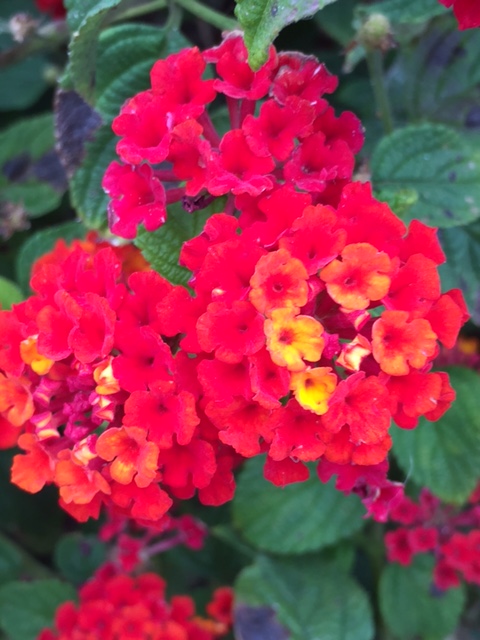
They bloom every day ’til they die, year round, a good 10 years. They grow fast too.
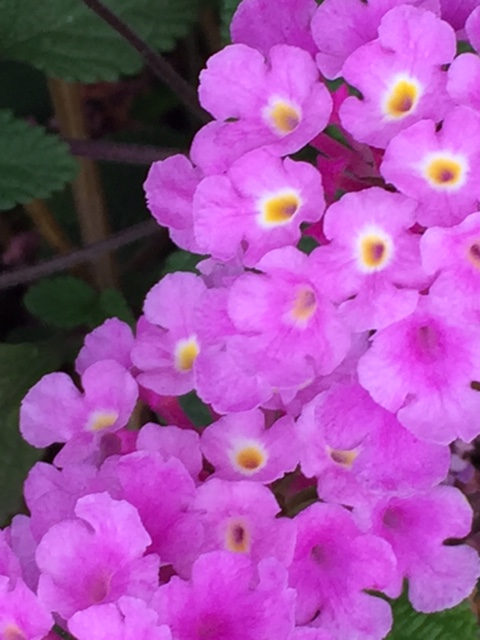
Every lantana flower head looks like a little bouquet. They smile in single colors (yellow, orange, pink, cream) or in combinations (magenta and yellow, purple and yellow, orange and yellow). One multi-colored variation called Carnival includes blossoms that are pink, red, lavender and yellow – all in one little bouquet.
Lantanas thrive here in our beach climate and I pass them every morning spilling from front yards onto the sidewalk. Time to buy one of my own and nestle it into my balcony garden. It’s crowded now, since I potted a jasmine, but there’s always room for one more flower, especially a happy one that will keep the color coming, even if times are not happy.
Lantanas are a tropical and subtropical plant that arrived here from Central and South America and are popular in the warmer coastal regions of the world. They like sun and don’t need a lot of water. Because they grow so quickly, they are considered invasive when they take over open areas, as in Australia. The flowers are poisonous to animals and can harm livestock. In gardens, they attract birds and butterflies.
Since I don’t have cattle grazing on my balcony, and my cats show no interest, I will focus on the birds and the butterflies. And how the lantana flower heads remind me of all occasions requiring bouquets.
Dances, graduations, weddings. Weddings across all ages and colors and genders. Celebrating the beauty of each individual and also the blending to create a whole. Saluting the welcoming, the bringing together, of divergent ideas to make us all stronger. The carnival of life for laughter and tears. Funerals, memorials, for those who sang and danced and are now gone but will not be forgotten.
In addition to Carnival, lantanas bloom in other varieties. Confetti. Pink Frolic. Radiation. Sunburst. Spreading Sunshine. Spreading Sunset.
I love these little cooking videos on speed. You know the ones I mean? The hands and ingredients fly together so quickly the dish makes itself!
Peach crumble cobbler in three easy steps, boom, boom, boom.
Cheese and egg bake, just layer in fast forward and throw in oven. Literally.
Avocado, chili and lime dip, zip and rip in blender with sea salt.
Little containers of sea salt, which, of course, everyone has lying around, appear magically in these revved-up recipes.
Are these videos inspiring? Yes, they inspire me to THINK about bringing something fancy to my next potluck or to invite friends for dessert or appetizers … or to venture beyond my basic meals. Not to actually DO, however.
What I want is that little hopped-up chef to pop right out of my computer onto my kitchen counter and get to work! On demand. Like a single-serve coffee brewer, only with more ingredients. And many, many ideas for delicious, healthy, fun meals.
If 3-D printers can now make many silly doo-dads and possibly human skin, why can’t we have little foodie nutrition robots to keep us well-fed? (I realize human skin may not be a good example here, but it’s for testing drugs and cosmetics, thus saving bunnies and mice.)
We already have the Roomba vacuum cleaner clanking around and soon we will have self-driving cars (a dream or a nightmare, I can’t decide), so why not mechanical chefs? They could be as varied as our budgets and dining rooms allow.
For party givers, cooking machines as large as a pantry. And stocked like a pantry too, with a big variety of menus and goodies for all sorts of events, from drop-in cocktail parties to sit-down five-course meals. And why not include cocktails, wines and beers to accommodate a variety of tastes and entertainment?
For families, a do-not-let-up diner, breakfast and lunch maker programmed to keep everyone healthy and away from the grocery store for at least a week, maybe two! Special program corners for fresh baby food and tea and coffee.
For singles, no sad-sack burritos or wasted leftovers. A compact robot friend to weigh out just the right amount of whatever appeals to us at the moment. Hey, one advantage of being single is that we can eat strange foods at strange times without reporting to anyone.
For health fanatics who are into juicing, a cute little citrus-colored robot replacing the blender and shooting out vitamin pills. Whipping up low-fat guacamole and hummus and spitting out the carrot and celery sticks.
Finally, let us not forget our animal friends, dogs, cats, birds, fish, reptiles and so on. Since I have three cats, part of my resident robotic chef would cater to them. It would know when they were in the mood for chicken pate and NOT flaky tuna bits, for example. No more stare-downs trying to outwit their stubbornness while the unwanted food of the day lumps into smelly cement.
So, move over Cuisinart and NutriBullet, I am making room. In June of 2015, Newsweek ran an article on the kitchen of the future: “Good to the Last Byte: Food Gets Digitized.” It pictured two big robot arms hovering over a stove. Seems creepy to me. Who wants to embrace two disembodied arms? No, I’m putting in my order for the whole little chef.
How much does luck play a part in our lives? Are some of us luckier overall than others?
Marilyn vos Savant answered a variation of this question in her “Ask Marilyn” column, which she has been writing for “Parade” magazine for 30 years. A man in Massachusetts asked her, “In what order of strength would you rank the following four influences on the outcome of our lives: environment, self-determination, genetics and luck?”
Her answer (ranking from first to last, summarized):
Genetics – makes the difference between whether we’re human beings, butterflies or peaches.
Environment – consider the difference between being raised in a leafy American suburb and in downtown Calcutta.
Luck – includes everything from the Industrial Revolution to war – the actions of all the other human beings in the world.
Self-determination – we can influence far more in our lives than many people think, but far less than the rest of them wish.
This particular column is about 15-20 years old, but something about it resonated with me and made me tear it out and paste it in one of my many idea notebooks. It makes sense to my analytical mind and practical, Scottish nature. And it still appeals to me as a way of understanding how and why we are, a general framework, although hopefully non-binding and allowing for embellishments, clarifications and individual variations.
Most of us don’t really think about Numbers 1 and 2. Those are givens we often take for granted, especially if they are good. Yes, I am a human being and I live in Southern California. But there are days I would rather be a tree, reaching for the sky and nesting birds and dropping leaves. Or for sure one of my cats lolling in the sun. But no, I am a human and I have to trim that tree if it is mine and pick up its leaves – and stuff my cats in cat carriers and take them to the vet and fork over about $300. And earn the money to pay for that.
I was born in Montreal but when I was 12 my parents moved to the beach area of Los Angeles. If we had stayed in Montreal, how would that altered my life? Would I have the same love of the ocean, of casual living, of lack of pretension? Would I have less sunshine wrinkles? More or less meaningful relationships?
I realize that the first two influences vos Savant listed – genetics and environment – have been mostly positive for me. Yes, I sometimes wish I were taller than 5 feet 3 inches, more athletic and outgoing. I joke with people that in my next life I plan to be bitchier, with the brain of Einstein (or vos Savant) and the body of a Las Vegas showgirl. But I am so grateful to be mostly healthy, especially as I slip into the “elderly” category. Ooops, no slipping, more like gliding … And I’m also grateful to have landed in a part of the world with beautiful beaches, bays and canyons and a moderate climate, geographically, politically and socially.
As for luck and self-determination, I like the way vos Savant ranks these also. She defines luck as where we are in relation to others in the world, to history. We are born into a certain family, social class, country. I feel fortunate to have been born in a time of opportunity and affluence for middle-class Americans and to have enjoyed a stable family. My parents were strict, but typical of that mid-century time, often left us to our own explorations. We then pushed beyond our boundaries, demanding and living through many personal and social changes. Sadly, my father died young, at 52 (bad heart genetics), which left a permanent loss within. In my only dream about him after he died, we were walking on the beach together and we came to a forest. “I have to leave you now,” he said. “You’ll be going into the forest alone, but you’ll be okay.”
And with the exception of a few lost pathways, I have been. I have always been determined and independent and that keeps me going even in dark, bramble-filled times. I realize that I cannot claim full credit, since genetics, environment and luck have all influenced me. I also realize, as Marilyn wisely says, that I could influence more in my life, but not everything. As in the serenity prayer, we dance between what we should accept and what we can change and hope for the wisdom to discern the difference.
I like this kinder, more complete way of looking and the world and ourselves, but of course it doesn’t let us off the hook completely. Self-determination may rank last according to one smart woman’s list, but it is still up to us to make the best of what we inherited, where we landed and whatever luck comes our way.
I have a hip new hobby. I didn’t realize it was hip until recently.
For Christmas, my kids gave me a coloring book and a set of colored pencils. (They gave me some other things too, like a totally cool lamp for my office.)
I was intrigued by the coloring book, but not thrilled. Do they think I am ready for the old fart farm?
My talent lies with putting words on paper, not drawings. As much as I wanted to paint and draw as a kid, I could never get beyond black, claw-like winter trees. (There were plenty of those in Montreal.)
A few days into this new year, I opened up the book on my dining table – Lost Ocean: An Inky Adventure & Coloring Book by Johanna Basford. I felt a little silly. Memories of being bored in kindergarten, Brownies and high school sewing.
The pages seemed overwhelming. All those sea bottoms and weird creatures and castles and hidden treasures. Where to start?
The answer is with one pencil stroke, of course. And then another. And then a pleasurable feeling of accomplishment as the black and white illustrations – including crabs with claws – came to life. Pages filled with color and the stroking motions to get there were soothing.
Soon I was looking forward to new pages, new color combinations, and whenever I had a spare few minutes, the book called to me. Waiting for a friend or a phone call? Color. Finished work, but not ready for dinner? Color. Feeling jittery watching all the terrible news on TV? Color. I found I could balance the book on my legs, even if sharing it with a cat, and color away. It is a relief not to have to look at any more car crashes, shootings, fires, ribbon cuttings or anchor women in sausage dresses and yet still keep informed. Beneficial multi-tasking.
I texted my kids with an illustration (my best work yet) and the message “I have become an addict.” And then I needed my fixes, new pencils. I couldn’t pass a stationery or art supply store without going in to check out their supply. Nor could I pass up the small art sections in the drug and grocery stores. Who knew there are now 25 kinds of crayons? I found some great push-up pencils by Crayola that don’t require sharpening. And a set of metallic pencils at Aaron Brothers that add a soft gleam. Recently spotted unusual colors in an expensive gift store. I picked up one in a gorgeous chartreuse and rolled it around in my fingers like I used to do cigarettes. But at $3 a pop, I can do without. For now, anyway.
I’ve also learned that certain instruments do not work, for example, markers. Except for highlighting tiny spots, they are too saturated, not subtle enough.
It’s the closest I come to being a real artist. Working for years in desktop publishing, as an adjunct to journalism and technical writing, I have a good eye for balance, color and design.
And the meditative benefit is a bonus!
In a few weeks, I finished the book and drove up to Book Star for a new one. To my surprise, the whole front window was filled with a display of coloring books. Inside, there was also a huge display – larger than sections for self-help, relationships, addictions and diets. And so many subjects to color. Birds. Animals. Flowers. Mandalas. Ethnic designs.
I picked “Enchanted Forest: An Inky Quest & Coloring Book,” also by Basford.
“I love to color,” said the young clerk as she checked me out. “And this Johanna is the woman who started it all.”
Then, of course, as often happens when you learn something new, you see it or hear about it everywhere. From friends and family:
“We use it in our stress management classes at work.”
“My daughter has a coloring group in her college dorm.”
Maybe the workers and students who color together stay calm and carry on together.
And now I see coloring books popping up in unexpected places, boutiques, newsstands. Even a blurb in the latest (May ’16) “Westways” magazine:
“Who says coloring books are just for kids? Trendy adults are taking up this hip hobby as a way to pass the time on long car rides or plane trips … intricate and soothing drawings will put “big kids” in vacation mode in no time.”
Me, I love Consumer Reports reviews. Items, from cars, stoves and lawnmowers to pharmacies and power bars tested and dissected. Results corralled into colorful graphs, easy to read or even tear out and carry in purse or pocket when I brave the Best Buy or Staples printer aisle. Those reviews appeal to the logical, objective, practical side of me.
But Consumer Reports does not review local shops and restaurants or that lamp or blouse I am considering online. So I reluctantly scroll down to reviews, comments, ratings. Occasionally they are helpful. Fifteen in a row, for example, about Chipotle’s Montezuma Revenge Burrito. Or a dozen ALL writing that the cheap table is made of cardboard and falls apart as soon as you set down a drink.
However, most reviews are a mixed collection of rambling, opposing opinions and reactions. At first they amuse me, then they annoy me, then they tire me, and finally they make me lose hope for humanity. I mean, if we cannot find some civil common ground on the neighborhood bakery, how can we debate clean water, good schools, and other policies?
How can several different people walk into that same bakery and see it so differently? One calls the owner “The Donut Nazi” and another refers to her as “a snobby bitch who ignored me.” The pastries are like rocks. To another reviewer, the owner was a cross between Mary Poppins and an Italian grandmother. The biscotti is the best she’s tasted since living in Tuscany.
Comments about restaurants are even more subjective. Terrible service, great food. Great service, terrible food. Loud, uncomfortable setting. Hip and friendly place. “Stacie our waitress forgot to write four separate checks.” “Stacie our waitress spilled wine on my husband but was so cute and bubbly we gave her a big tip anyway.” Suddenly everyone reviewing online is a food and wine expert – and most have never worked in restaurants, you can tell.
Clothing items are also confusingly rated. Too small, had to send back. Ran large so I gave it to my aunt. Itchy material and the buttons popped off. Nice for the price, extremely comfortable and I loved the buttons. Would I recommend to a friend? No, never. Yes, in fact I ordered two more in different colors. With such mixed reviews, it’s hard to know where the truth lies and whether to charge ahead or pass.
I refrain from writing nasty reviews. Only once did I complain online – about a florist. I had ordered a floral bouquet for my sister’s birthday and was picking it up on my way to Los Angeles. When I stopped to pick it up, my car loaded with clothes and other getaway items, the owner was not there and the clerks had no record of the order. They kindly offered to assemble an arrangement. It was beautiful. I was annoyed at having to wait before getting on the freeway, but no big deal. I thought the owner would call me to apologize, but she never did. So I logged into Yelp! and complained. She then called me, saying she had neglected to write down my order and my phone number and had no way of contacting me until I posted online. She offered me free flowers and I took down the comment.
It IS tempting when someone in a store or restaurant is rude to rant and yelp. The equivalent of tattling when we were kids. Does it accomplish anything? Maybe the clerk was having a hard day, maybe his rent check bounced or his hours got cut or a girlfriend dumped him. Not that bad behavior should be tolerated forever, but I honestly believe most clerks are doing the best they can (see my blog post, These Clerks, They are A-Tryin’).
So as fascinating as it is to delve into the world of retail trolling, I look forward to my next issue of Consumer Reports.
George Lakoff has retired as Distinguished Professor of Cognitive Science and Linguistics at the University of California at Berkeley. His newest book "The Neural Mind" is now available.

 I just got yelled at in a parking lot for taking too long to push my cart. The woman (not young or old) in a big white van shouted, “Get a move on!”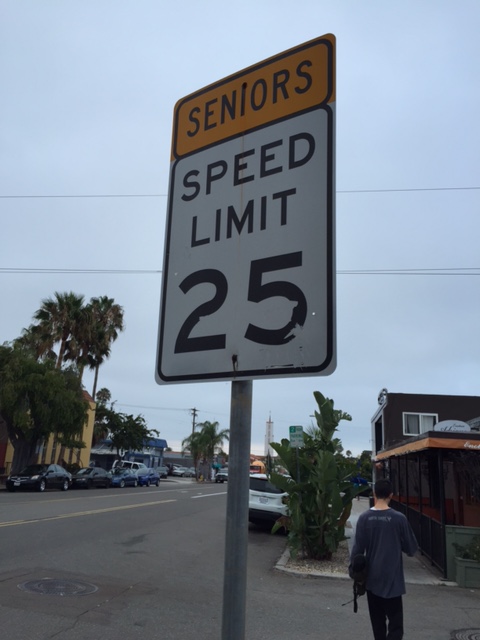




![images[2]](https://headwindjournal.com/wp-content/uploads/2016/04/images2.jpg)


 head wind journal